- Home
- Login
- Insert an ad
- Blog
- Live Sex
-
Languages:


- Contact us
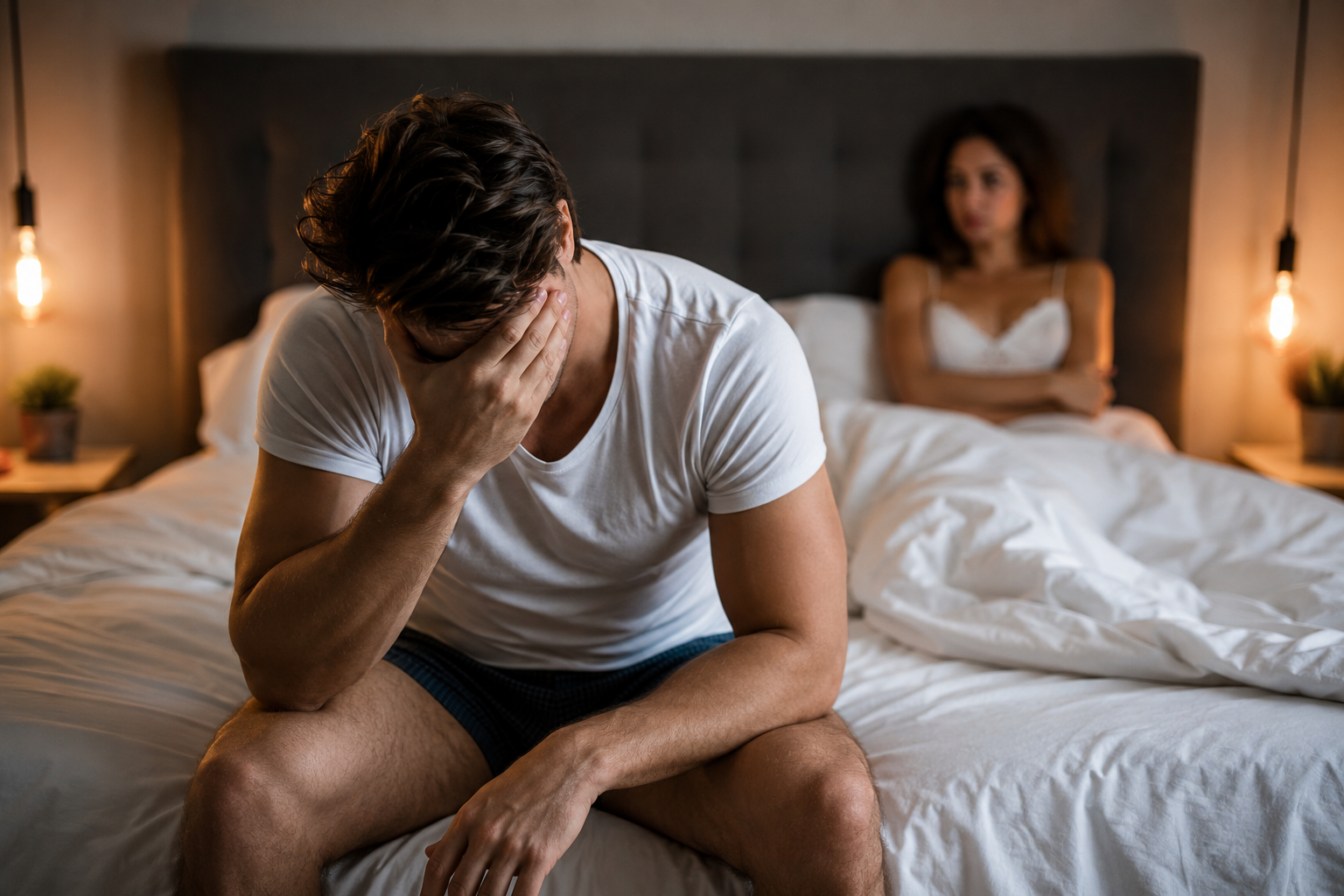
It happens more often than people admit. The date is going well, the partner is attractive, the desire is there, the body should follow… and yet nothing goes as planned. Or not enough. Or not for long. In your head, panic starts fast: "Why can't I get hard with a new partner?" Brutal question, but a very human one. And above all, much less rare than the bar-counter alpha males would like everyone to believe.
The scenario is almost always the same. An apartment that feels slightly too warm, a perfume lingering on the skin, a half-finished drink on the table, a few messages exchanged before meeting. Everything seems aligned. Then, at the exact moment the encounter becomes truly sexual, the brain decides to open 14 tabs at once: am I going to perform? Is she judging me? Does she really like me? Is it going to happen again like last time? Well done. Curtain down.
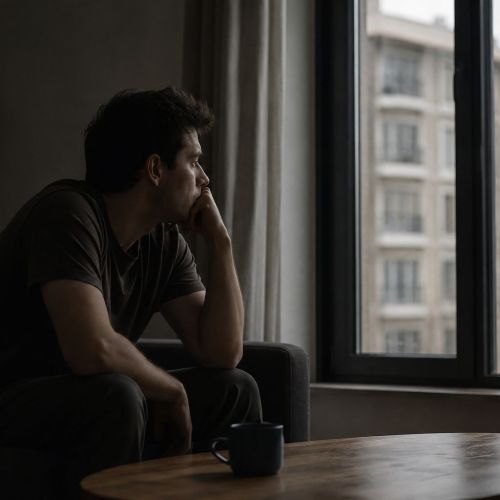
The first thing to understand is this: not getting an erection with a new partner does not necessarily mean you do not want her. Sometimes, it is even the opposite. The more attractive she is, the more the pressure rises. And the more the pressure rises, the more the body can freeze. A charming male paradox: wanting to do too well can be enough to sabotage everything.
In adult encounters, whether they happen in Lausanne, Geneva or elsewhere in French-speaking Switzerland, many men arrive with a very theatrical idea of performance. You are supposed to get hard instantly, last a long time, guess her desires, stay confident, never shake. As if sex were a practical exam graded out of 6. Reality is less glamorous, but far more interesting: the human body is not a machine that responds on command.
One man explained that he completely lost his nerve during a first date in Lausanne. He found the woman beautiful, funny and very free in the way she spoke. That was precisely the problem. The more she turned him on, the more he feared disappointing her. He spent the evening smiling, joking, keeping up appearances. His body, meanwhile, had left the conversation.
A new partner is an unknown territory on several levels. Her gaze, her gestures, her rhythm, her scent, the way she touches, sometimes even her silence. Everything has to be discovered. For some men, this novelty is fuel. For others, it feels like a spotlight aimed straight at their face. You feel watched, judged, almost exposed before you are even naked.
There is also comparison, that discreet little poison. Comparison with the other person's past partners, with scenes seen online, with the image you would like to give of yourself. And suddenly, sex becomes mental. Too mental. But erections rarely enjoy internal debates, calculations and disaster scenarios. They prefer presence, breathing, contact, letting go. Simple things, which of course become difficult when you absolutely want to succeed.
The brain can slow down arousal like a safety pedal. Even with desire, even with an attractive partner, stress can send the opposite message to the body: "not now, danger". Not very sexy, but biologically quite logical.
The real mood-killer is not always alcohol, fatigue or age. Very often, it is that silent sentence: I have to perform. It sounds virile. In reality, it is exhausting. It turns a moment of pleasure into a service to be delivered. And nobody is truly erotic when they are monitoring themselves like a quality control inspector.
Some men start checking their erection before they are even aroused. They test. They monitor. They worry. And by constantly checking whether it works, they prevent it from working. It is like staring at a pot of water and demanding that it boil immediately. Except here, the pot has pride.
Forcing it, apologising 10 times, justifying yourself for 20 minutes or constantly asking "does it bother you?" often makes the situation worse. The embarrassment then becomes the centre of the scene, when it could have remained a simple incident.
Let's avoid the tedious health lecture, but let's be clear: an exhausted body responds less well. A heavy week, a big meal, 3 drinks too many, poor sleep, work stress that sticks to the skin… all of this can break the momentum. Many men want spontaneous sexuality with a body that is already drained. Optimistic. Almost poetic.
Porn can also play a role, especially when it becomes the main reference point for arousal. By getting the brain used to fast, intense, always-available images, a real encounter can seem slower, more subtle, less immediately controllable. With a real partner, there are pauses, awkward moments, breathing, bodies that do not react exactly as expected. In short, something alive. And living things sometimes need time to adjust.
There is something many men never say out loud: sometimes, they are less intimidated by sex itself than by a woman's gaze. A partner who embraces her own desire can be unsettling. A woman who is confident, direct and openly sensual can throw off a man who thought he was completely self-assured. It is not a shameful weakness. It is simply the gap between the image you have of yourself and the reality of the moment.
The problem is that many men interpret a single incident as definitive proof: I'm not a real man, I'm useless, this is going to happen every time. That is the wrong conclusion. A temporary erection problem is not an identity. It is a signal. Sometimes a sign of stress, sometimes fatigue, sometimes a lack of confidence, and sometimes simply a situation that does not feel right.
A man who regularly met partners in Geneva explained that he never had any issues once he knew someone, but first dates always made him tense. His breakthrough was not a miracle technique. It was one simple sentence his partner said one evening: "We're not in a hurry." For the first time, he no longer felt as though he had to prove himself within three minutes.
The first solution is almost insultingly simple: slow down. Not the kind of slowing down preached in a wellness podcast by someone wearing linen trousers. Really slow down. Breathe, touch, kiss, stay focused on sensations instead of monitoring your penis like the dashboard of a car. The more your attention returns to your partner and to physical sensations, the less room fear of failure has to grow.
It can also help to rethink what sexual success actually means. A great encounter is not measured by having a perfect erection from beginning to end. There is flirting, attraction, hands, mouths, words, silence and rhythm. When penetration becomes the only proof of masculinity, everything else disappears. And that is a shame, because everything else is often where sex becomes truly exciting.
If it only happens once or twice, only with a new partner or during particularly stressful periods, there is usually no reason to panic. However, if erection problems become frequent, last for several months, occur even when you are alone, or are accompanied by a significant drop in sexual desire, it is worth talking to a doctor. Not to be lectured, but to check what can actually be checked: blood circulation, hormone levels, medication, anxiety or chronic fatigue.
The most dangerous part is often the vicious circle. One erection problem creates fear, fear causes another erection problem, and the next one confirms the fear. It is the classic self-fulfilling cycle, bedroom edition. Breaking free usually means stopping the habit of treating every intimate encounter like a test. Sex is not a vehicle inspection.
With a new partner, an erection sometimes says less about desire than it does about your sense of emotional security. Feeling desired, accepted and free to be imperfect changes everything. Many men actually perform better once they stop trying to impress. It sounds almost irritatingly simple. But it is true.
So no, not getting hard with a new partner does not mean everything is doomed. It may simply mean that your body needs less pressure, more time and a little less theatre. It may also be asking for a healthier view of sex, one that is less obsessed with performance. In the end, adult sexuality becomes far more satisfying when you stop playing a role. You breathe. You touch. You listen. And sometimes, the very moment you stop trying to command your body, it quietly comes back into the room.
Yes. This is far more common than many men think. During a first intimate encounter, stress, fear of disappointing someone or performance pressure can block an erection, even when desire is clearly there. An isolated episode is usually not a sign of a health problem.
Yes. When the brain focuses on fear of failure or on the partner's gaze, it becomes harder to stay connected to physical sensations. The body can then trigger defence mechanisms that slow down or block the erection, even when sexual arousal is strong.
The worst reaction is to panic. It is better to slow down, keep touching and kissing, communicate simply with your partner and avoid turning the incident into a disaster. In many cases, the pressure naturally drops and the erection comes back without needing to force anything.
If the difficulties repeat over several weeks or months, happen with every partner, or also occur during solo sex, it is advisable to speak to a doctor. This helps rule out a medical cause and find the right solution before stress starts keeping the problem alive.