- Home
- Login
- Insert an ad
- Blog
- Live Sex
-
Languages:


- Contact us
There’s one thing that always raises a smile when you take a closer look at the world of adult dating. Men are supposedly obsessed with sex. Women, on the other hand, are said to crave emotions, connection, and perhaps a little candlelight. It’s a story that has been repeated for so long that it almost feels like an unquestionable truth.
The problem is that it matches reality less and less.
After browsing countless profiles, reading private conversations, and talking with escorts, swinger couples, and single people who openly embrace their desires, a different picture starts to emerge. One that is more nuanced. And, in many ways, more interesting.
Because there can be a huge gap between what someone truly desires and what they choose to show.
Let’s not pretend otherwise. Many men express their sexual desire quite openly. They make the first move, send the first message, and quickly suggest meeting in person. Some are subtle about it. Others, not so much.
On erotic dating and adult classifieds platforms, it often takes only a few minutes to notice the pattern. A new profile goes online. Messages start arriving. Then more messages. Then even more.
This visibility creates a persistent impression: that male libido is stronger.
But is it really stronger? Or simply more visible?
An escort recently shared something quite revealing. According to her, many men still believe that women want sex less than they do. Yet when she talks with female clients, friends, and acquaintances, she often notices the exact opposite.
The difference is not always about the intensity of desire. More often, it’s about how that desire is managed.
When a woman receives dozens of approaches and invitations, she naturally develops selection criteria. She becomes more selective. More attentive. Sometimes more cautious.
From the outside, this can look like a lack of interest. In reality, it is often simply a process of filtering.
An experienced professional from Lausanne summed it up with humor: "The challenge isn’t finding someone who wants you. The challenge is finding someone who makes you want them."
The quote made everyone laugh. Yet it’s hard to argue that it isn’t true.
This is probably where the debate often goes off track.
People tend to compare men and women as if they were two perfectly uniform groups. Yet spending just one evening in a swinger club is enough to understand that the differences between individuals can be enormous.
Some men talk endlessly about sex but rarely act on their fantasies. Some women appear reserved for hours before becoming the most adventurous people in the room. Others prefer fantasy over reality. Others are constantly looking for new experiences.
Libido does not follow a single universal rule.
It is much more like a combination of personality, upbringing, circumstances, and opportunities.
Several studies on sexuality have shown that differences in sexual desire between two people of the same gender are often greater than the average differences observed between men and women.
This stereotype refuses to disappear.
Many people assume that a healthy man should want sex all the time, as if his brain were equipped with a single button labeled "desire."
Reality is far less dramatic.
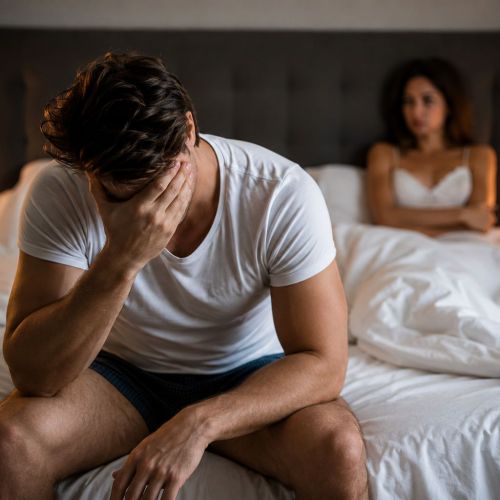
Stress, financial concerns, exhausting work schedules, relationship issues, or simply fatigue can significantly reduce libido for days or even weeks.
Many men struggle with this because they fear something is wrong with them. In truth, it is incredibly common.
In fact, countless men are surprised to discover that others experience the same thing once they finally feel comfortable talking about it.
A simple everyday situation is often enough to prove it.
Your phone vibrates late in the evening. An unexpected name appears on the screen. A conversation that ended weeks ago suddenly resumes. The exhaustion that felt overwhelming ten minutes earlier seems to vanish instantly.
Desire thrives on details.
A voice. A fragrance. A particular tension during dinner. A lingering glance that lasts a second too long.
People often talk about hormones, and they certainly matter. But the brain remains the true conductor of the orchestra.
And that conductor loves to improvise.
During a private event in Geneva, one organizer explained that he regularly observes the same phenomenon. Men often arrive convinced that they are the most enthusiastic participants. A few hours later, some discover that several women had been looking forward to the event for weeks and were far more excited than they were.
Because it is simple.
Saying that men have a stronger libido than women allows people to place the world into neat, easy-to-understand categories. It feels comfortable. Fast. Convenient.
Unfortunately, human beings rarely fit neatly into the boxes designed for them.
Female desire is often more discreet than people imagine. Male desire is sometimes more fragile than people admit. And between the two lies an endless spectrum of possibilities.
Assuming that someone who has many sexual partners automatically has a high libido can be misleading. Curiosity, habit, loneliness, or the search for validation can sometimes play a greater role than sexual desire itself.
When conversations become genuinely honest, the differences between men and women often appear far less dramatic than expected.
The fantasies are there. The desires are there. The frustrations are there as well. Many people dream of novelty. Many enjoy the thrill of seduction. Many simply want to experience their sexuality without feeling judged.
The real difference often lies in how each person manages their desire and how much freedom they allow themselves to express it.
Ultimately, the question may not be who has the stronger libido. The more interesting question is why we continue to assume that it should be so different in the first place.
After observing thousands of conversations, profiles, and encounters, one conclusion keeps returning: desire does not belong to men or women. It belongs to individuals. And it has a remarkable talent for making stereotypes look foolish.
Not necessarily. While men often express their desire more directly, this does not mean their libido is always stronger. Many women experience sexual desire just as intensely, but may express it differently or in a more selective way.
This impression largely comes from the fact that men tend to talk more openly about their desires and are often more likely to take the first step in adult dating. Their desire is usually more visible, but that does not mean it is necessarily stronger than women’s desire.
Yes. Many stereotypes still portray women as less interested in sex. Yet studies and personal experiences show that many women have a strong libido, varied fantasies, and a genuine interest in exploring their sexuality.
Libido depends on many factors, including hormones, stress, fatigue, self-confidence, relationship quality, emotional context, and overall health. Sexual desire naturally changes over time, depending on life stages and personal experiences.
Absolutely. Lower sexual desire can affect both men and women. Stress, everyday worries, relationship difficulties, or simple tiredness can temporarily reduce the desire for sex without this being abnormal.
Not necessarily. The number of sexual partners does not always reflect the intensity of someone’s libido. Curiosity, the desire to seduce, the search for validation, or certain life circumstances can also influence sexual behavior.
Above all, there are individual differences. Each person has their own way of experiencing desire. Differences in libido between two people of the same gender can be greater than the average differences observed between men and women.